


Mathematics & statistics
Measure error, then investigate it.
MSE = Σ(ŷᵢ − yᵢ)² / n
Compare estimates with held-out observations. Report error by person, time horizon and setting; an average can conceal an important failure.
Our research
Investigating better management, earlier recognition and the biological barriers to durable treatments and potential cures.

Every biomedical capability needs more than a plausible story. These foundations guide the questions we ask and the evidence we seek.
Define what is being estimated, which assumptions matter and how uncertainty will be measured.
Connect the question to the right population, measurement and biological process.
Preserve the identity of compounds, assays, genetic variants and the context in which they are studied.
Test against strong baselines, independent data and the needs of people who will use the result.
We want to understand what a model can tell us, how uncertain that answer is, and whether it remains useful beyond the data it learned from.
Concept illustration only. Points represent observations; the dashed line represents an estimate. The shaded region illustrates uncertainty, without a fitted model or numerical confidence level.
Which population, tissue, measurement or stage of life does this question concern? Evidence should retain that context.
We plan to compare transparent baselines, quantify error and check how estimates behave across people and settings.
An ingredient, compound, genetic variant and laboratory assay are distinct pieces of evidence. Their identity and conditions matter.
Our standard is independent testing and a defined human use, with limitations and useful negative results reported alongside findings.
These are our research principles. This illustration does not demonstrate forecasting accuracy, clinical effectiveness or an available medical product.
Computational science
Our model research brings physiology, chemistry and statistical learning together. A useful computation must preserve what a measurement means and reveal where an explanation could be wrong.
Inside one neural unit
A neural network combines weighted inputs and nonlinear transformations. Change these dimensionless example values to see a single ReLU unit respond.
a = max(0, w · x + b)
max(0, 1.2 × 0.8 − 0.2)
Educational arithmetic. Not a trained model or a health prediction. Bias b is fixed at −0.2; no data leaves this page.
Mathematics & statistics
MSE = Σ(ŷᵢ − yᵢ)² / n
Compare estimates with held-out observations. Report error by person, time horizon and setting; an average can conceal an important failure.
Biomedicine & physiology
dQ/dt = Rᵢₙ − Rₒᵤₜ
This general conservation relationship illustrates compartment-model thinking. A physiological model also needs defined quantities, consistent units, measured parameters and experimental validation.
Chemistry & molecular biology
Compound identity, concentration, tissue, assay and exposure belong beside a finding. A cell-level observation is a starting point for investigation, not evidence of a treatment effect in people.
Empirical validation & engineering
Independent cohorts, reproducible experiments, calibrated uncertainty and reviewer feedback guide progress. A larger neural network must earn its place against a simpler method.
Our publication agenda spans qualified datasets, reproducible benchmarks, methods and, when appropriate, prospective clinical studies.
Traceable sources, realistic evaluation splits and clear analysis protocols make findings easier to inspect and challenge.
When a complex model fails to outperform a simple one, that finding belongs in the record too.
Our research programs are proposed or in development. We do not yet have published Diabeteris clinical results.
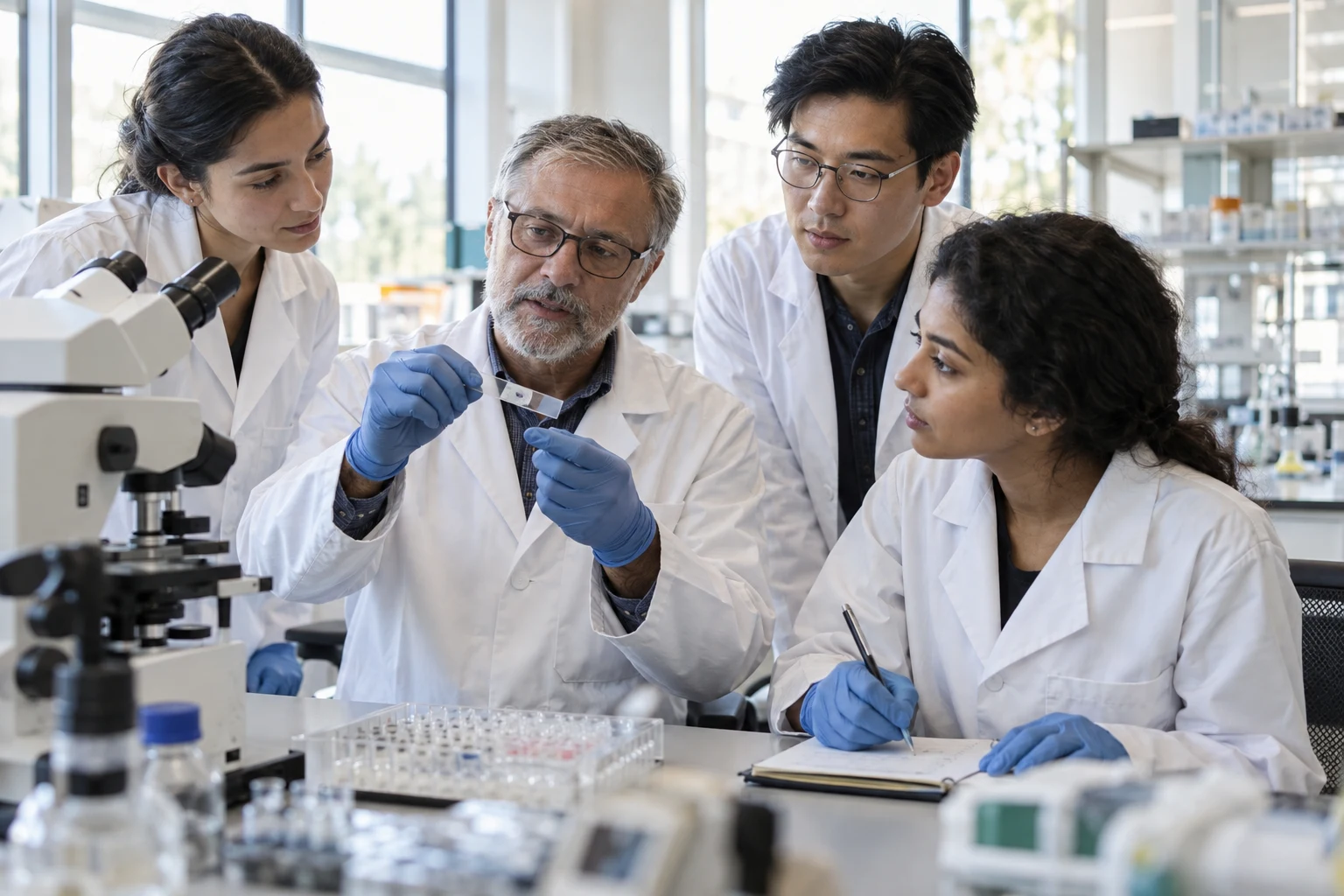
Our ambition includes collaboration with scientists, universities, clinicians and public-health researchers, with clear protocols and reproducible analysis.
Bringing academic expertise and engineering together around a research question.
Studying population patterns starts with understanding the source, context and limits of the data.
The foundation behind the work
We are building a shared diabetes evidence library, the Metra model research program and Foundry’s controlled data workflows to support our research and future applications.
Research partnerships
Discuss a study, a data source or a practical need with us.
Contact us