Study changes in glucose
Compare methods for analyzing measurements over time. Test how their errors change across people, devices and study settings.
AI research
Our Metra research program explores statistical models, machine learning and deep neural networks. Lens brings document intelligence, evidence retrieval and later LLM assistance to the same scientific foundation.
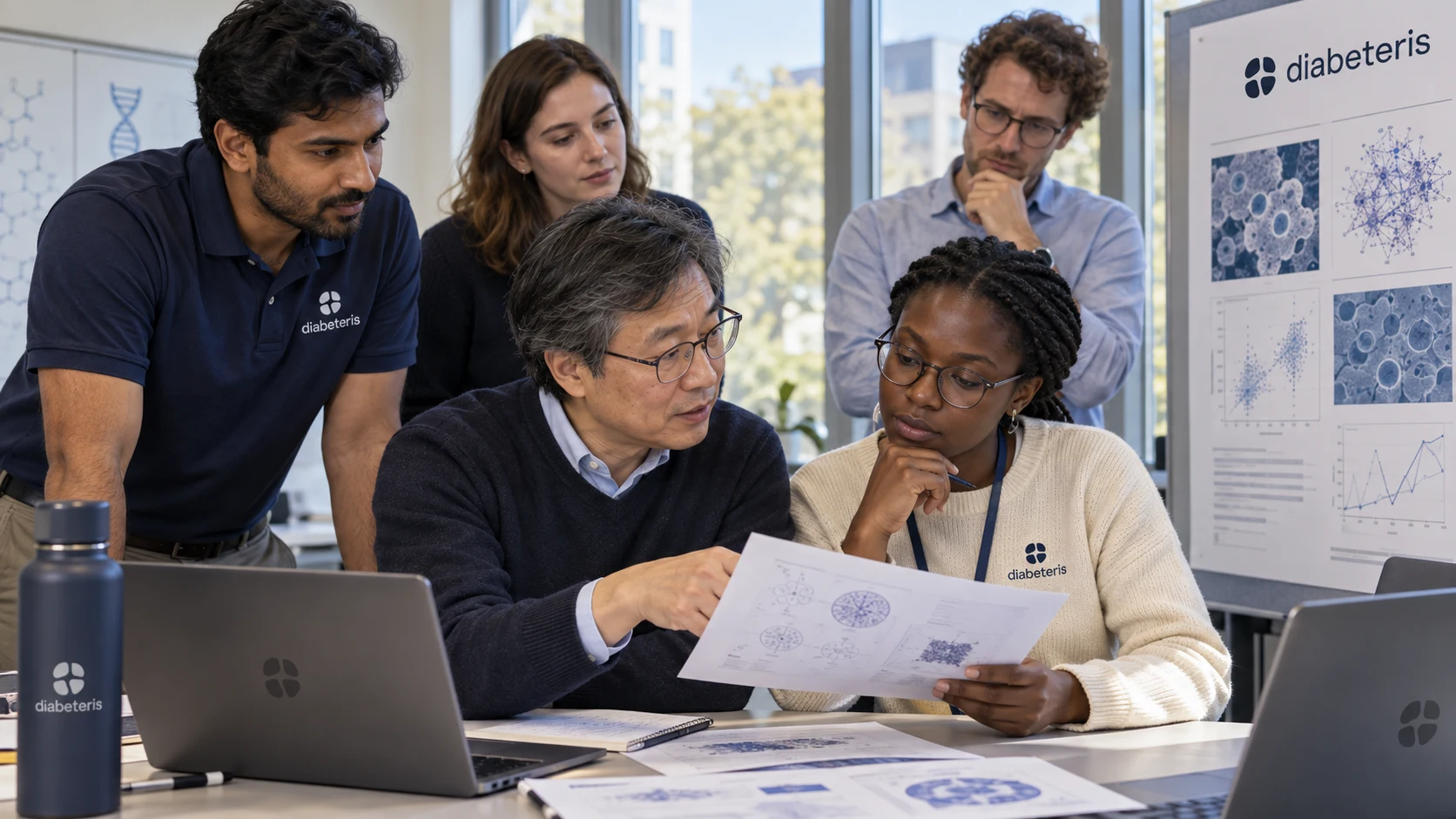
A useful model must do more than produce a convincing answer. Our research plan compares it with a simpler method, checks errors and missing information, and asks whether another team can reproduce the result.
The Metra research program
Metra is our planned family of computational models for diabetes research. Metra-1 establishes statistical and machine-learning comparisons. Metra-2 explores temporal neural networks and deep learning when the data and benchmarks justify the added complexity.
Alongside Metra, Lens connects OCR, natural language processing and evidence retrieval. Later LLM-assisted workflows would help researchers read and compare authorized sources, with citations and human review.
These are development programs. We have not released a validated clinical model, and the research workflow does not determine insulin doses.
Explore model researchResearch portfolio
Development roadmap
No model benchmark is running here.
Statistical & machine-learning research
Does a candidate improve on a simple reference method for the same study?
Compare methods for analyzing measurements over time. Test how their errors change across people, devices and study settings.
Use text recognition and language processing to propose fields from reports and papers. Preserve units, dates and statements such as “family history” so a mention is not mistaken for a diagnosis.
Search for passages relevant to a research question. Keep citations visible and identify where studies disagree or do not answer the question.
Explore bounded research assistants that carry out defined tasks and record what they did. People review important findings and decide what needs further testing.
We want to understand what a model can tell us, how uncertain that answer is, and whether it remains useful beyond the data it learned from.
Concept illustration only. Points represent observations; the dashed line represents an estimate. The shaded region illustrates uncertainty, without a fitted model or numerical confidence level.
Which population, tissue, measurement or stage of life does this question concern? Evidence should retain that context.
We plan to compare transparent baselines, quantify error and check how estimates behave across people and settings.
An ingredient, compound, genetic variant and laboratory assay are distinct pieces of evidence. Their identity and conditions matter.
Our standard is independent testing and a defined human use, with limitations and useful negative results reported alongside findings.
These are our research principles. This illustration does not demonstrate forecasting accuracy, clinical effectiveness or an available medical product.
Computational science
Our model research brings physiology, chemistry and statistical learning together. A useful computation must preserve what a measurement means and reveal where an explanation could be wrong.
Inside one neural unit
A neural network combines weighted inputs and nonlinear transformations. Change these dimensionless example values to see a single ReLU unit respond.
a = max(0, w · x + b)
max(0, 1.2 × 0.8 − 0.2)
Educational arithmetic. Not a trained model or a health prediction. Bias b is fixed at −0.2; no data leaves this page.
Mathematics & statistics
MSE = Σ(ŷᵢ − yᵢ)² / n
Compare estimates with held-out observations. Report error by person, time horizon and setting; an average can conceal an important failure.
Biomedicine & physiology
dQ/dt = Rᵢₙ − Rₒᵤₜ
This general conservation relationship illustrates compartment-model thinking. A physiological model also needs defined quantities, consistent units, measured parameters and experimental validation.
Chemistry & molecular biology
Compound identity, concentration, tissue, assay and exposure belong beside a finding. A cell-level observation is a starting point for investigation, not evidence of a treatment effect in people.
Empirical validation & engineering
Independent cohorts, reproducible experiments, calibrated uncertainty and reviewer feedback guide progress. A larger neural network must earn its place against a simpler method.
Compute & security roadmap
We plan to scale from controlled local research to high-memory systems, GPU-accelerated training and distributed experiments as the data, funding and evaluation justify them.
Planned controlled research environment
Infrastructure as code · Separate research and production environments · Tested recovery
Our planned workloads span machine learning, deep neural networks, computational models and later large language models. We will select hardware against memory needs, reproducibility, training time and cost, with capacity and benchmarks documented as infrastructure is commissioned.
AWS GovCloud (US) is a deployment option we intend to evaluate for eligible workloads. Account eligibility and regional service availability must be confirmed. This is an infrastructure plan, not a claim of an existing GovCloud deployment or certification.
Our planned controls include least-privilege access, encryption in transit and at rest, isolated workloads, audit trails, restriction propagation and tested backups. Cloud hosting does not replace application security or governance.
Define what the model must do
Compare with a simpler method
Report errors and uncertainty
Keep people able to inspect the evidence
Models are in development. We do not offer a validated diagnostic, diabetes-risk or insulin-dosing model through this website.
Work with us on a research question